Confidential Email Disclaimer: Examples and Best Practices
Learn how to write an effective confidential email disclaimer with practical examples. Protect your sensitive messages in 2026.
Most corporate email footers pretend to be stronger than they are. A few dense lines about confidentiality, legal privilege, prohibited disclosure, and liability rarely create a binding obligation for someone who never agreed to them. Legal commentary consistently treats these notices as signaling and deterrence tools, not automatic legal shields, and the legal history of email confidentiality notices shows why boilerplate alone has limited force.
That doesn't make a confidential email disclaimer useless. A well-written notice can tell an unintended recipient what to do, reinforce an existing duty under an NDA or professional relationship, and document the sender's intention to keep information private. A bad one creates false confidence, obscures the actual instruction, and gives employees an excuse to skip stronger controls.
Table of Contents
- What a Confidential Email Disclaimer Actually Does
- Core Elements of a Strong Disclaimer With Ready-to-Use Wording
- Three Disclaimer Lengths You Can Copy and Customize
- How the Disclaimer Performs in a Group Email Mistake
- Jurisdiction Notes for the U.S., U.K., EU, Australia, and Canada
- Applying Disclaimers in CC, BCC, and Group List Settings
- Layering Disclaimers With Classification, DLP, and Privacy Notices
- Quick Reference Checklist and Copy-Ready Examples
What a Confidential Email Disclaimer Actually Does
A footer line doesn't manufacture confidentiality. If the recipient has no contractual, professional, statutory, or other legal duty to protect the information, the notice usually can't create that duty after the message arrives. Courts and practitioners generally assess the underlying relationship, the nature of the information, applicable privilege, and the surrounding circumstances rather than treating boilerplate as a contract.
The practical value is narrower and more useful. A confidential email disclaimer can make a recipient pause before forwarding, copying, publishing, or replying to the wrong audience. It can also support an argument that the sender took reasonable steps to communicate an intention of confidentiality when an existing duty already applies. That's evidence and notice, not a technical barrier.
Practical rule: Write the disclaimer for the person who receives the email by mistake, not for a judge who has already seen the facts.
Three categories often get confused:
- Contractual confidential information is protected because an NDA, employment agreement, vendor contract, or similar arrangement creates obligations. The footer can remind recipients of those obligations, but it doesn't replace the agreement.
- Privileged communications may receive protection because of the legal relationship and purpose of the communication. Adding “privileged” to a footer doesn't make an ordinary business email attorney-client privileged.
- Personal data is governed by privacy and data-protection duties. A notice may help communicate handling expectations, but it doesn't replace lawful processing, access restrictions, retention rules, or a formal privacy notice.
The U.S. Internal Revenue Service's decision to end the need for the long-used Circular 230 disclosure in taxpayer-facing emails in 2014 illustrates the danger of treating traditional footer language as mandatory protection. A legal review of email disclaimers also highlights how limited the formal doctrine remains despite the ubiquity of these notices.
Use the footer to signal intent, provide a clear recovery instruction, and reinforce a real control. Don't use it to claim that forwarding is impossible, privilege is automatic, or a recipient has accepted new terms by reading an email.
Core Elements of a Strong Disclaimer With Ready-to-Use Wording
A useful disclaimer answers one question immediately: what should the recipient do if this message wasn't meant for them? Build around that instruction, then add only the legal language your organization can support.
Identify the recipient and the information
Start with a direct scope statement:
“This email and any attachments may contain confidential information intended only for the named recipient.”
“May contain” is usually safer than declaring every message confidential. If your organization uses classification labels, make the footer match the label rather than turning routine correspondence into a legal event.
Give the mistaken recipient a clear action
The recovery instruction should be specific:
“If you received this message in error, please notify the sender, do not read, copy, forward, or disclose it, and delete the message and attachments.”
That wording tells the unintended recipient what not to do and creates a practical path for correction. It's more effective than “unauthorized use is prohibited,” which sounds forceful but doesn't explain the next step.
Mention the actual legal basis
Use privilege or contractual language only when it applies:
“Any confidentiality obligations arise from the applicable agreement or professional relationship, including [agreement name], where relevant.”
For legal correspondence, a narrower formulation is better:
“This communication may contain information protected by legal professional privilege where that privilege applies.”
Don't label an email “attorney-client privileged” merely because a lawyer appears in the recipient list. Privilege depends on substance, purpose, participants, and jurisdiction.
Add operational and liability language sparingly
A virus or alteration statement can sit outside the confidentiality instruction:
“Recipients should check attachments using their own security procedures. [Company name] isn't responsible for changes made after transmission.”
A jurisdiction reference may be appropriate in a formal corporate template:
“This notice is governed by the laws applicable to [jurisdiction], subject to any mandatory rules that cannot be excluded.”
That clause won't decide every dispute, and it shouldn't suggest that mandatory privacy duties disappear.
A compact combined version could read:
“This email and any attachments may contain confidential information intended only for the named recipient. If you received it in error, please notify the sender, do not read, copy, forward, or disclose it, and delete it and any attachments. Any confidentiality or privilege applies only where supported by an applicable agreement, professional relationship, or law.”
This structure follows practical disclaimer guidance from Exclaimer, which emphasizes intended-recipient identification, notification, deletion, plain language, consistency, and periodic review. Keep the final footer short enough that recipients can understand it without legal interpretation.
Three Disclaimer Lengths You Can Copy and Customize
Length should follow risk and audience, not a lawyer's appetite for caveats. A sales representative sending a public product overview doesn't need the same footer as an HR manager sharing employee information.
Comparison at a glance
| Length | When to Use | Sample Wording | |---|---|---| | Short | External sales, routine inquiries, and low-risk business correspondence | “Confidentiality notice: This email may contain information intended only for the named recipient. If you received it in error, please notify [Company], don't copy or forward it, and delete it.” | | Medium | Typical professional email, vendor discussions, internal escalations, and contract administration | “This email and its attachments may contain confidential information for the named recipient only. If received in error, notify [Company] at [contact], don't read, copy, forward, or disclose it, and delete it. Any confidentiality obligation depends on the applicable agreement, professional relationship, or law. This notice is subject to the laws of [jurisdiction].” | | Full | Legal, healthcare, HR, regulated, and high-sensitivity correspondence | “This communication and its attachments may contain confidential information, personal data, or legally privileged material intended solely for the named recipient. If you aren't the intended recipient, notify [Company] at [contact], don't read, copy, forward, disclose, or rely on it, and delete all copies. Privilege applies only where recognized by applicable law and the relevant professional relationship. Handle personal data under [privacy policy] and applicable requirements. [Company] doesn't accept responsibility for alteration after transmission. This notice is governed by [jurisdiction], subject to mandatory legal duties.” |
The short version works because it gives the mistaken recipient a single clear response. Don't burden it with a privacy-policy summary or a sweeping jurisdiction clause that readers will ignore.
The medium version is the sensible default for most organizations. It explains the notice's limits instead of implying that the footer itself forms a contract.
The full version should be controlled, not pasted everywhere. Add a privilege reference only to correspondence where legal privilege could realistically arise. Add personal-data language when the message contains or discusses personal data, and link to the organization's actual privacy policy rather than reproducing it in the footer.
How the Disclaimer Performs in a Group Email Mistake
Consider an HOA board treasurer who sends a vendor contract summary to the owner distribution list and copies a contractor who should not see the negotiated pricing. The mistake is already made. The footer can't retract the message or make the contractor's mailbox inaccessible.
A clear notice can still improve the next decision. If it says the message is intended for named recipients, asks the unintended recipient to notify the sender, and instructs them not to read, copy, forward, or disclose it, the contractor receives an immediate behavioral cue. The board can then request deletion and document the correction without pretending that the disclaimer solved the incident.
The social signal matters. A specific instruction makes later misuse look deliberate rather than accidental, particularly where an existing confidentiality obligation applies. A generic block saying “this email is confidential and unauthorized disclosure is prohibited” is weaker because it gives the recipient no clear recovery process.
The board should also review the distribution method, remove unnecessary addresses, and decide whether the vendor contract needs a restricted channel or access-controlled document. A group email can expose both content and recipient identities, so organizers should understand the broader risks discussed in this guide to private email list management.
A disclaimer doesn't create legal privilege, prevent discovery, override a valid subpoena, or stop someone from taking a screenshot. It also doesn't eliminate the board's responsibility to assess whether personal data, contract terms, or other sensitive information was exposed. Treat the footer as one part of the incident response, then fix the workflow that caused the error.
Jurisdiction Notes for the U.S., U.K., EU, Australia, and Canada
Confidentiality notices don't carry identical weight everywhere, but the central recommendation is consistent: localize the wording and don't overpromise. A footer should support the organization's actual legal and privacy program, not claim that a single sentence overrides mandatory law.
| Jurisdiction | Legal Weight | Recommended Wording Focus | Common Pitfall | |---|---|---|---| | U.S. | Usually evidence of intent, not a binding contract by itself | Identify the recipient, give deletion and notification instructions, and refer to an actual agreement or privilege relationship | Claiming the recipient accepted contractual terms by receiving the email | | U.K. | A notice may reinforce reasonable handling expectations and existing duties | Use plain English, identify the intended recipient, and connect the notice to applicable confidentiality and data-protection policies | Treating the footer as a substitute for Data Protection Act obligations | | EU | Relevant as a communication layer within a GDPR-oriented privacy framework | Refer to authorized handling, the organization's privacy notice, and established access controls | Suggesting the disclaimer itself establishes a lawful basis for processing | | Australia | Can support documented handling expectations under a broader privacy program | State what an unintended recipient should do and align the wording with organizational safeguards | Presenting the footer as the organization's complete Privacy Act compliance measure | | Canada | May form part of organizational safeguards and documented practices | Pair confidentiality instructions with the applicable privacy policy and contact route | Treating the notice as a standalone requirement under PIPEDA |
For the U.S., a workable clause is: “Any confidentiality or privilege applies only where supported by an applicable agreement, professional relationship, or law.” That language respects the distinction between notice and obligation.
For U.K., EU, Australia, or Canadian use, add a functional privacy reference: “Handle personal information under [Company]’s privacy policy and applicable data-protection requirements.” Link to the policy in the signature if recipients need more detail. Don't cram data-subject rights, retention periods, or processing purposes into a confidentiality footer.
Use translations where employees and recipients operate in different languages. A translated notice should preserve the action verbs, recipient scope, and limitations of the approved version. The jurisdiction-focused guidance on U.S. email disclaimers specifically underscores that these notices generally aren't required by law across major markets, including the U.S., U.K., EU, Australia, and Canada. That makes accuracy and fit more important than theatrical length.
Applying Disclaimers in CC, BCC, and Group List Settings
Email distribution changes the risk. A one-to-one message gives the sender a chance to check the recipient. A CC chain expands the audience with every reply, while BCC can conceal recipients from one another but also creates broken conversations and reply-all confusion.
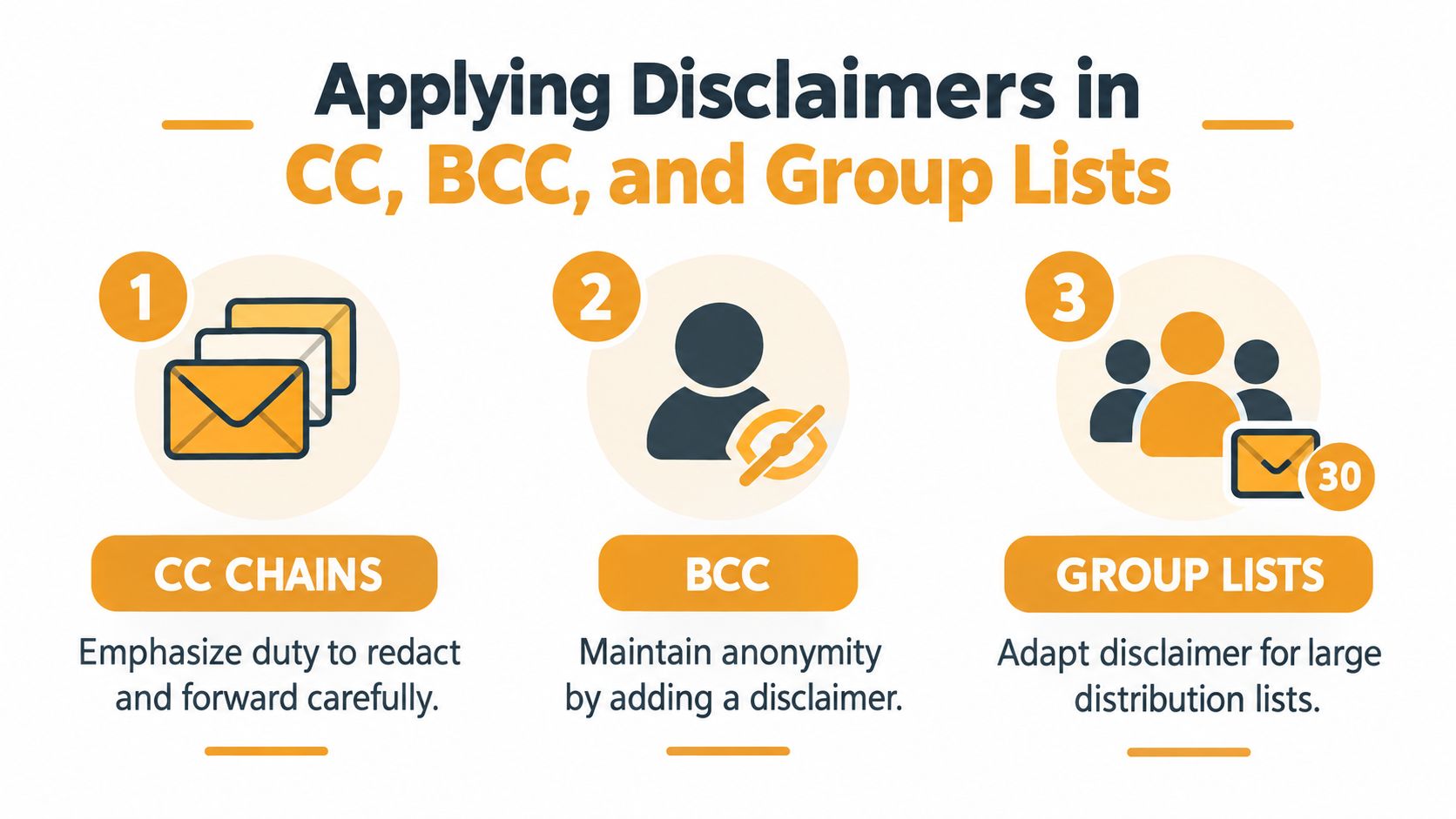
CC chains need recipient discipline
For CC, the footer should reinforce careful forwarding:
“Recipients must check the audience before replying, forwarding, or adding others to this conversation.”
That sentence won't stop an accidental reply-all, but it addresses the behavior that creates the risk. Employees should also redact pricing, personal data, and internal commentary before forwarding a thread.
BCC protects less than people assume
BCC can hide addresses from other recipients, but the disclaimer doesn't create anonymity and can't correct an exposed To or CC field. A recipient can still forward the message, reveal the content, or reply in a way that exposes the thread. The comparison of CC and BCC workflows is useful when choosing between hidden distribution and a controlled group address.
For announcements, BCC may be adequate when replies aren't needed. For discussion, it often causes missed participants and fragmented replies.
Group lists need a visible reminder
A large distribution list deserves a short header line before the body:
“Private group communication. Please verify the audience before forwarding or replying.”
Keep the footer concise, because recipients need the instruction before they open attachments or respond. Use a fuller notice only for internal compliance escalations, sensitive HR matters, legal communications, or messages governed by a specific agreement.
A public newsletter usually gains little from a confidentiality disclaimer. A confidential board update gains considerably more, especially when the sender pairs the notice with restricted membership, careful list administration, and a clear reply workflow.
Layering Disclaimers With Classification, DLP, and Privacy Notices
A footer is the outermost and weakest ring of a confidentiality program. It communicates intent after the recipient has already received the message. Classification labels, technical controls, and privacy notices do different jobs and should remain distinct.
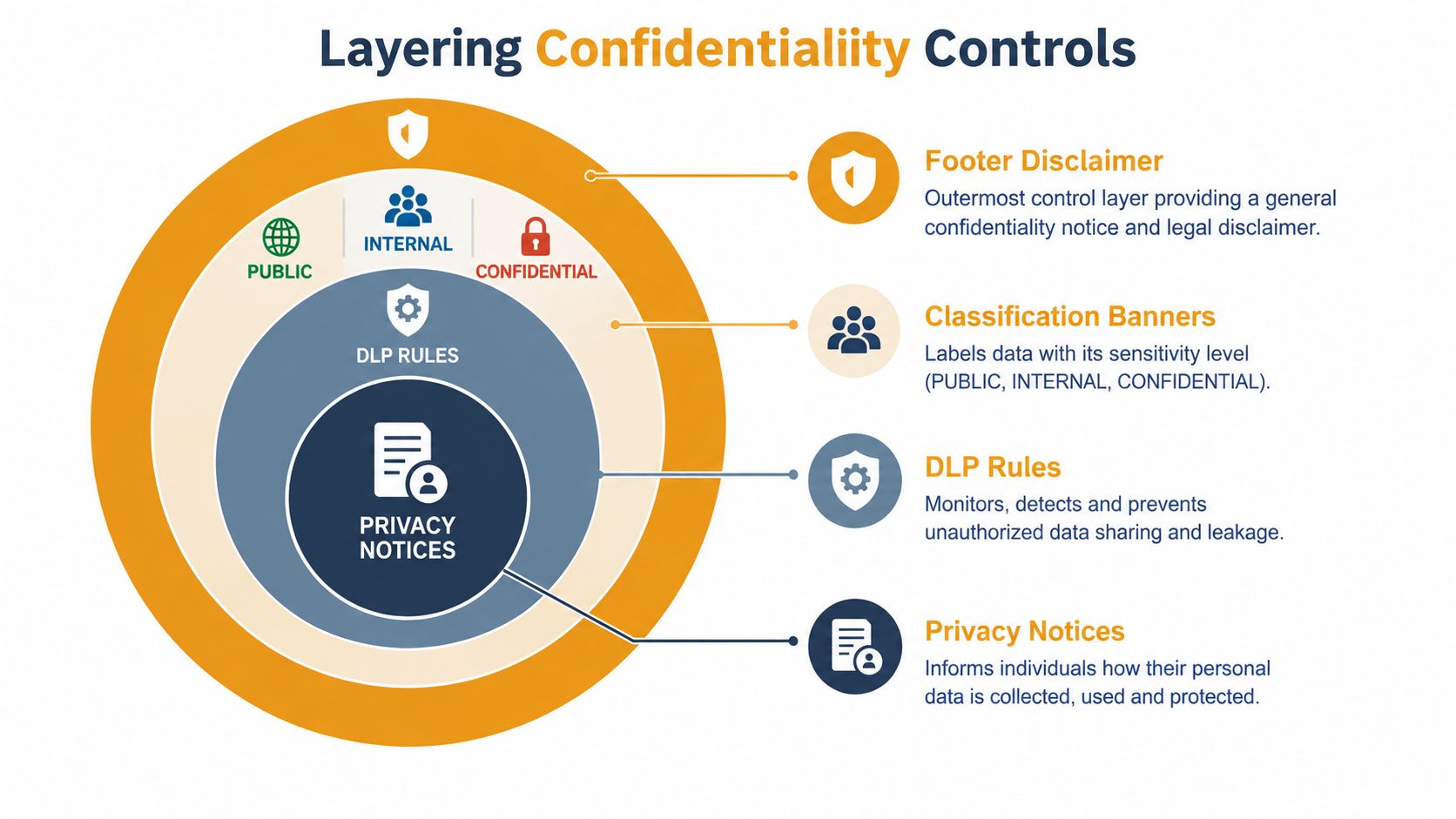
A sensible reading order looks like this:
- Classification banner: Put labels such as PUBLIC, INTERNAL, CONFIDENTIAL, or RESTRICTED in the subject line or at the top of the message body.
- Message content: Give recipients the business information and any handling instructions that apply to the file or conversation.
- DLP controls: Let technical rules detect, warn about, quarantine, or block risky transmission where the organization has deployed them.
- Footer disclaimer: Reinforce the intended audience and provide the mistaken-recipient response.
- Privacy notice: Direct people to the policy that explains personal-data handling, rights, and organizational responsibilities.
The layers solve different problems. A classification banner tells a colleague how to treat the message. Data Loss Prevention can apply technical friction when a user sends restricted content outside the organization. A privacy notice explains processing and transparency obligations. The footer tells an unintended recipient to stop, notify, and delete.
For example, an HR email might carry “CONFIDENTIAL” in the subject, trigger a DLP warning when sent externally, include only the necessary employee information, link to the company privacy policy, and finish with a short confidentiality notice. Removing the footer would weaken the signal and recovery instruction, but the classification and DLP controls would still perform most of their respective functions.
Don't duplicate the privacy notice inside the footer. A long paragraph about lawful bases, cookies, retention, and data-subject rights muddies the confidentiality instruction and makes the whole block harder to read. Keep the privacy policy separate, then connect the two with a precise link. Organizations managing list-based communication should also review their email list management practices so recipient access and footer wording support the same policy.
Quick Reference Checklist and Copy-Ready Examples
Use this checklist before deploying a company-wide footer. The wording should reflect what your organization does, and counsel should approve any claims about privilege, jurisdiction, regulated data, or liability.
| Verification point | Suggested wording | |---|---| | Confidentiality status | “This email may contain confidential information.” | | Recipient scope | “It is intended only for the named recipient.” | | Mistaken delivery | “If received in error, notify the sender.” | | Deletion | “Delete the message and all attachments.” | | No forwarding | “Don't copy, forward, disclose, or distribute it.” | | No automatic contract | “This notice doesn't create obligations beyond those supported by applicable law or agreement.” | | Virus and alteration | “Check attachments using your own security procedures; transmission may be altered after sending.” | | Jurisdiction | “This notice is subject to the laws of [jurisdiction], subject to mandatory duties.” | | Privacy policy | “See [privacy policy link] for personal-data handling information.” | | Contact and version | “Privacy contact: [address]. Footer version: [date or identifier].” |
The earlier length comparison provides a practical three-tier model. Use these blocks as starting points, not as universal legal text.
Short business version
This email and any attachments may contain confidential information intended only for the named recipient. If you received it in error, please notify [Company], don't copy or forward it, and delete it. This notice doesn't create obligations beyond applicable law or agreement.
Standard corporate version
This email and any attachments may contain confidential information intended solely for the named recipient. If you received it in error, please notify [Company] at [contact], don't read, copy, forward, disclose, or distribute it, and delete the message and all attachments. Any confidentiality or privilege applies only where supported by an applicable agreement, professional relationship, or law. Handle personal data under [Company]’s privacy policy: [link]. This notice is subject to the laws of [jurisdiction], subject to mandatory legal duties. Please check attachments using your own security procedures.
Regulated-industry version
This communication may contain confidential information, personal data, or information that may be protected by legal professional privilege or applicable healthcare requirements. It is intended only for the named recipient and authorized participants. If you received it in error, notify [Company] at [contact], don't read, copy, forward, disclose, or distribute it, and securely delete the message, attachments, and copies. Privilege and confidentiality apply only where recognized by applicable law, professional relationship, agreement, or policy. Handle personal data according to [Company]’s privacy policy and applicable GDPR requirements. Where health information is involved, use approved safeguards and workflows designed to support HIPAA obligations. This footer doesn't make email secure or establish compliance by itself. Privacy requests can be sent to [privacy contact]. Footer version: [identifier].
Have counsel review the selected block before deployment, especially the regulated-industry version. Then test rendering in Outlook, Gmail web, and Apple Mail, including replies, forwards, mobile views, attachments, and group-list delivery. A footer that breaks into unreadable text or pushes the signature out of view has failed its communications job.
Listava gives community organizers a private group email address that reaches members while hiding personal email addresses and preserving group replies through ordinary email clients. If your HOA, club, faith group, or volunteer team relies on CC and BCC, visit Listava to evaluate a group-email workflow that supports clearer recipient control.