Indirect Channel of Distribution: Pros, Cons, and Examples
Learn what an indirect channel of distribution is, how intermediaries reach customers, its pros and cons, and real examples for group communication.
You're probably staring at a list that lives in someone else's inbox. A meeting date changed, a volunteer stepped down, or a new family joined, and now you're not sure who got the last message. That's not a writing problem. It's a delivery problem, and it's exactly where an indirect channel of distribution starts to make sense.
Table of Contents
- Why Products Rarely Travel in a Straight Line
- How an Indirect Channel of Distribution Works
- Weighing the Pros and Cons of Going Through Intermediaries
- Real-World Examples of Intermediary Partners
- Why Group Communication Can Work as an Indirect Channel
- Deciding Between Direct and Indirect Routes for Your Group
- Taking the Next Step With Your Group List
Why Products Rarely Travel in a Straight Line
A book club organizer doesn't always hand each member a note in person. She might ask the library to post the next title, leave flyers at a local café, or send details to one volunteer who forwards them to everyone else. The message arrives, but it took a detour first.
Think of a relay race. The first runner doesn't run the whole track. She hands the baton to the next person, who hands it on again. Each handoff can help the team cover more ground, and each handoff can also cause a fumble.
When the Carrier Becomes Part of the Message
That café owner decides where the flyer sits. The volunteer decides when to forward your note and whether to add a comment. A printer might delay a neighborhood newsletter for a day. You wrote the words, but someone else shapes timing, reach, and reliability.
- A shop can add visibility: A notice on a busy counter reaches people you don't know yet.
- A helper can add trust: A familiar neighbor's forward feels different from a message from a stranger.
- A helper can also add delay: If that person is busy, traveling, or confused, your update waits.
None of that means the detour is bad. It means you can't judge a route only by asking whether the message left your hands. You also need to ask who carried it, what they changed along the way, and what happens if they stop carrying it.
This happens with goods, too. A farmer rarely drives every box of produce to every kitchen table. A small maker rarely visits every store that might stock her candles. Other businesses step in to carry, store, display, and sell.
Who carries your message matters as much as what the message says.
Once you see those middle stops clearly, better questions follow. What does each intermediary do? What do you gain and give up? How do you choose a partner well, and what does this mean when the thing traveling isn't a parcel but a group email? We'll work through those questions in order, starting with the basic chain.
How an Indirect Channel of Distribution Works
An indirect channel of distribution is a route where a producer doesn't sell straight to the final user. Instead, one or more intermediaries step in between. Those intermediaries can be wholesalers, distributors, agents, or retailers who help move goods or services to the customer.
The diagram below shows the simplest version of that handoff.
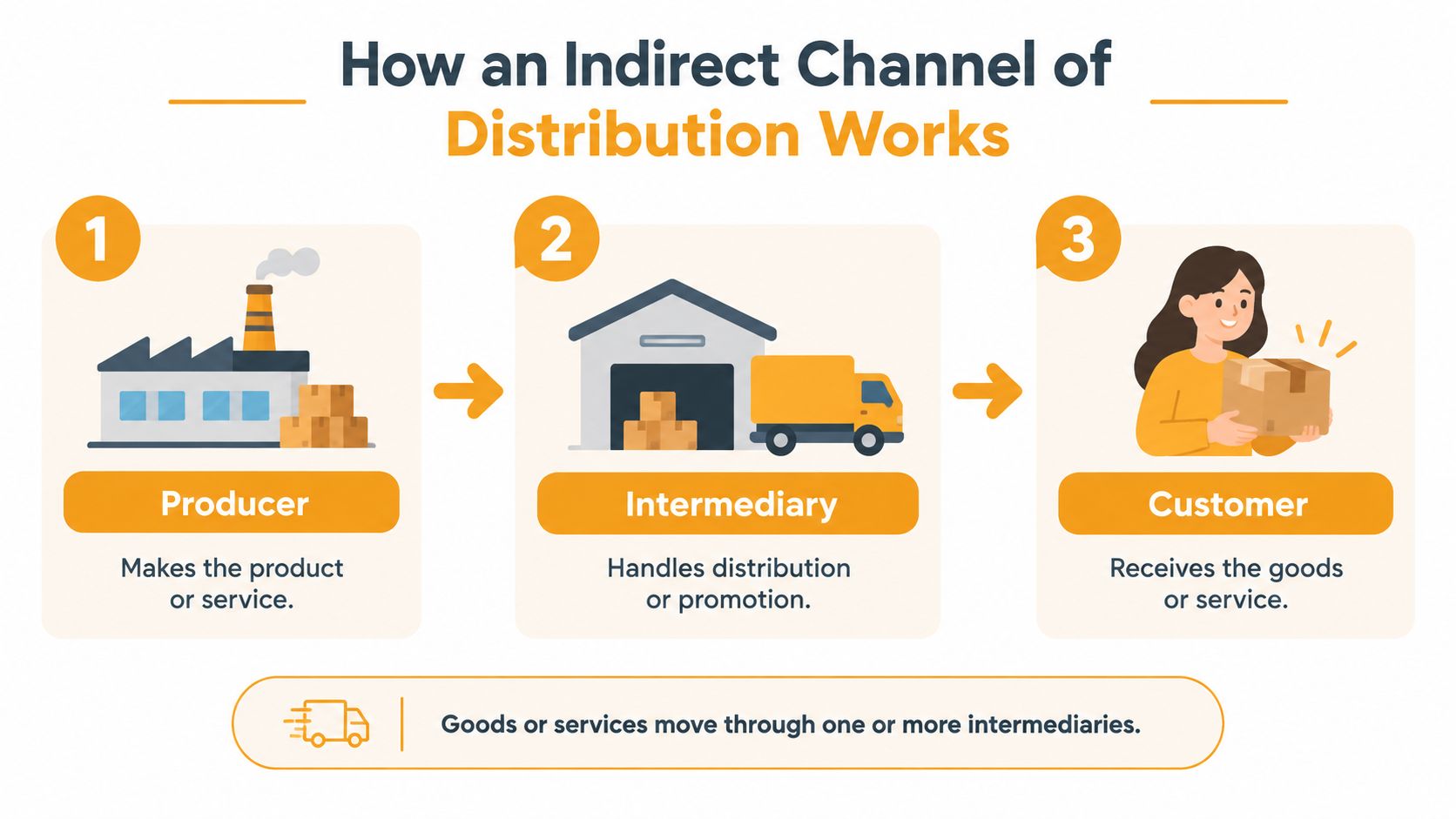
Use a neighborhood bakery as your mental picture. The bakery bakes bread in the morning. Instead of opening counters across town, it sells loaves to a grocery store, and shoppers buy the bread there. The bakery made the product, but the store handled the final sale.
The Standard Chain Step by Step
A classic sequence looks like this: manufacturer → wholesaler → retailer → consumer. Each stop has a practical job.
- Manufacturer makes the goods: This is the bakery, factory, farm, or workshop where the product starts.
- Wholesaler buys in bulk: The wholesaler purchases large quantities, stores them, and resells smaller lots to businesses. According to Britannica's overview of marketing intermediaries and distribution channels, wholesalers sell primarily to other firms, often in bulk and at lower than retail prices.
- Retailer faces the customer: The retailer creates a useful assortment, puts items where buyers can find them, and provides the final point of sale.
- Consumer buys and uses it: The final user rarely deals with the manufacturer at all.
Some chains are shorter. A manufacturer might sell directly to retailers, with no wholesaler. Others use an agent or distributor, someone who connects producer and buyer, arranges sales in a territory, or carries stock closer to customers.
Contrast that with a direct channel. There, the bakery sells from its own counter and keeps the customer relationship itself. No store decides shelf placement, and no wholesaler holds inventory.
Try tracing one item in your kitchen. Who made it, who stored or transported it, and who sold it to you? If you can name a business between maker and buyer, you're looking at an indirect channel of distribution at work.
Weighing the Pros and Cons of Going Through Intermediaries
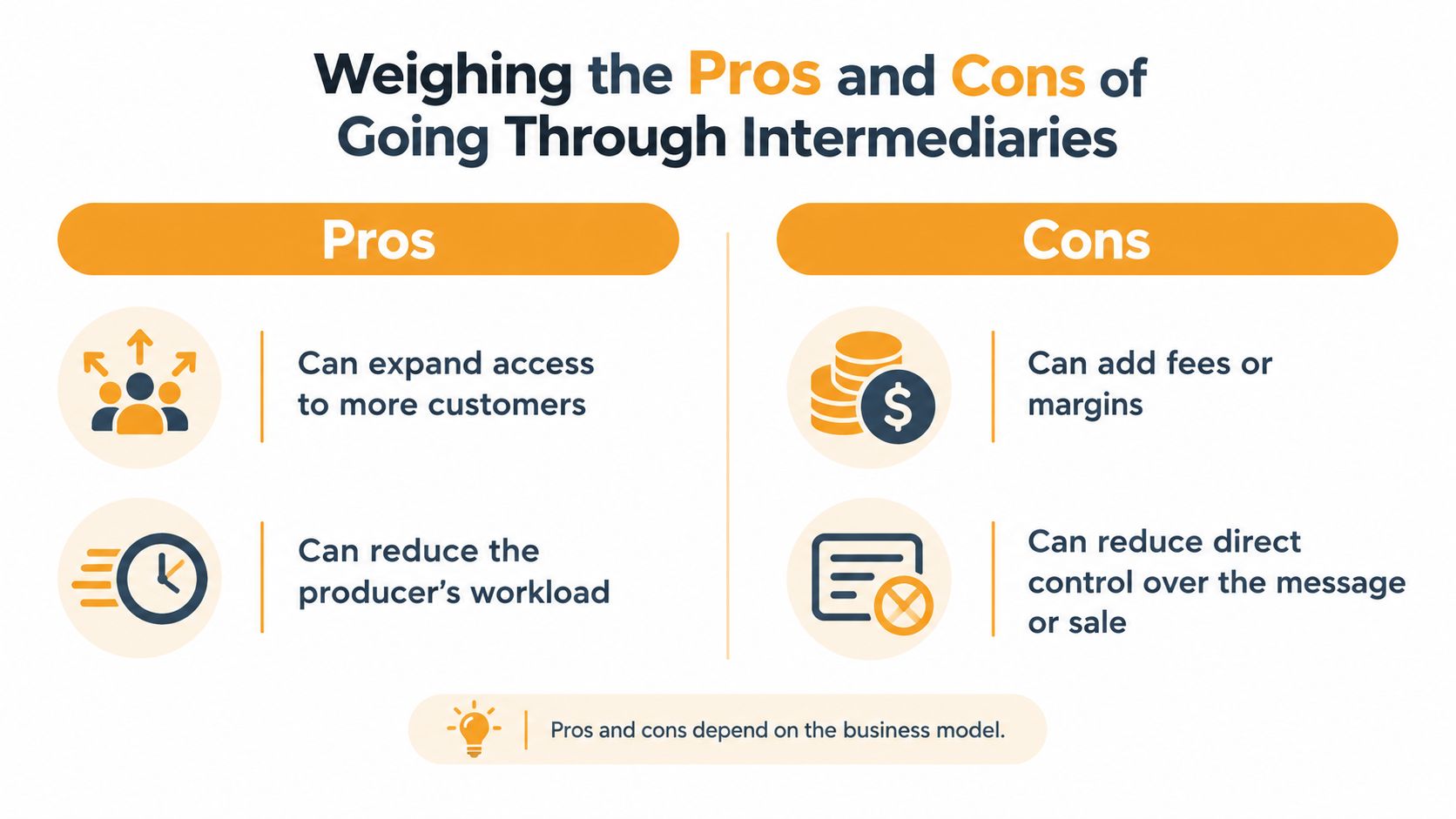
Intermediaries aren't extra steps for the sake of it. They're businesses that aggregate demand from many buyers, spread the costs of storage and selling, and give a producer access to customers it couldn't reach alone. The question isn't whether middlemen are good or bad. It's whether what they do is worth what you give up.
This image frames the trade-off in plain terms.
What Intermediaries Do Well
- Wider reach: A retailer or distributor already serves scattered customers. You borrow that network instead of building your own from zero.
- Shared costs: Warehousing, display space, and day-to-day selling effort sit partly with the partner, not only with you.
- Room to focus: A maker can spend more time making a good product while partners handle local sales and stock.
- Local knowledge: A partner who knows a neighborhood or trade can place the right items in front of the right buyers.
Those benefits are strongest when customers are fragmented and expensive to reach one by one. If buyers already come to your door, an intermediary adds less.
Where the Costs Appear
You also lose some control. The retailer decides how prominently to display your goods and how staff describe them. You may learn less about your final customers because the partner owns much of that daily contact. And your results depend on the partner's effort, which you don't fully direct.
Pricing is where many readers get confused, so let's slow down. Double marginalization means each business in the chain adds its own markup while thinking mainly about its own profit. Stack those markups, and the final price can end up higher than a single coordinated business would charge, which can shrink demand for everyone. Research on channel conflict and coordination in e-commerce describes this pricing distortion and a related problem, intermediaries investing too little in sales effort.
A useful test: Would you still use this partner if you could see their markup, their effort, and their customer list clearly?
Ask a few honest questions before you commit. Does this partner reach people you can't reach yourself? What will the final price look like after everyone's cut? Who talks to unhappy customers, and who decides discounts? If the answers are clear and the reach is real, the cost of going indirect is often justified.
Real-World Examples of Intermediary Partners
Examples make the roles easier to spot. Don't just note that a middleman exists. Ask what that partner provides that the producer lacks: access, storage, trust, or local knowledge.
A regional distributor might carry cleaning supplies from several manufacturers to independent shops. The shops get one delivery and one invoice instead of many. The manufacturers reach small stores that would be too costly to visit one at a time. Here, the intermediary's value is storage, transport, and an existing route.
Digital Intermediaries at Retail Scale
An online marketplace plays a similar role without a physical shelf. Small sellers list products in one place, and shoppers arrive because the marketplace already attracts them. The intermediary provides traffic, payment handling, and familiarity.
Retail data shows how large that digital route has become. In 2023, e-commerce accounted for 15.4% of all U.S. retail sales, up from 14.7% in 2022, according to the U.S. Census Bureau quarterly e-commerce report. During the second quarter of 2020, e-commerce reached an estimated $211.5 billion and 16.1% of total sales. The intermediary didn't disappear online. It changed shape.
Offline routes still matter. Historically, wholesalers were sometimes the main means of trade in less-industrialized countries, serving as central infrastructure across parts of Latin America, East Asia, and Africa. In Japan, products could pass through a minimum of five separate wholesalers before reaching a retailer until the late 1950s. Long chains happen when markets are fragmented and producers need many layers of local access.
A trade association works differently. It may promote a member's training course or supplier offer to its membership. Its asset isn't a warehouse. It's trust and a ready audience. A community organization sharing a local service with families it already serves does much the same.
Not Every Partner Deserves the Same Terms
Bargaining power matters. Stronger retailer bargaining power lowered the wholesale margin by approximately 7% and increased total channel profits by 1% to 6% in studied settings, partly because lower wholesale margins eased double marginalization, according to an empirical investigation of retailer bargaining power. But when store-brand positioning increased by 50%, wholesale margins fell by about 24% while channel profitability declined by 13% to 19%. Power helps when it improves coordination. It hurts when it turns partners into rivals.
Judge partners by role, not by headcount.
- Trusted access partner: A community group that introduces you to its members may deserve a simple referral arrangement.
- Large platform partner: A marketplace demanding deep discounts should show volume, retention, and real incremental reach.
- Service partner: A distributor who handles support should be judged on margin after support costs and how many customers get activated.
Signing more partners isn't progress by itself. Progress is partners who bring new, lasting customers at a cost you can explain.
Why Group Communication Can Work as an Indirect Channel
Now swap loaves of bread for announcements. A homeowners association board, pickleball club, faith community coordinator, or family organizer also has something to deliver. The recipients are scattered, busy, and not equally comfortable with technology.
A shared group email address works like an intermediary. You send one message to the group address, and the list delivers it to every member. You don't paste dozens of personal addresses into each new email.

That single address provides the same core functions as a retail intermediary. It creates market access, in this case access to the whole membership. It holds the assortment, which here means the current member list, in one place. It also keeps personal addresses private while letting replies stay inside the group.
Why Familiar Tools Often Win
Digital channels aren't automatically the inclusive choice. Market research on indirect MRO distribution estimates offline channels represented 68.3% of market share in 2025 while online channels represented 31.7%, though online distribution was growing faster at 7.8% annually versus 3.9% for offline, according to DataIntelo's indirect MRO distribution market report. The lesson for small groups is simple. New tools spread quickly, but much real work still depends on people and access methods they already have.
Standard email can be that access method. Members already know how to open it. They don't need another password, app, or dashboard. That's why comparing group communication tools built around shared email lists helps organizers weigh reach against training burden.
The short video below shows this group address idea in action.
Listava is one example of this model. An organizer creates a group address, adds members by CC or imports them in bulk from a spreadsheet, and members take part entirely by email. The list can outlast one volunteer's term, which matters when leadership rotates.
Be candid about limits, though. A small family thread may work fine with CC. A one-way announcement list may tolerate BCC, and some groups are happy in Google Groups or a Facebook group. Use the intermediary when privacy, continuity, and easy replies matter more than keeping things utterly informal.
Deciding Between Direct and Indirect Routes for Your Group
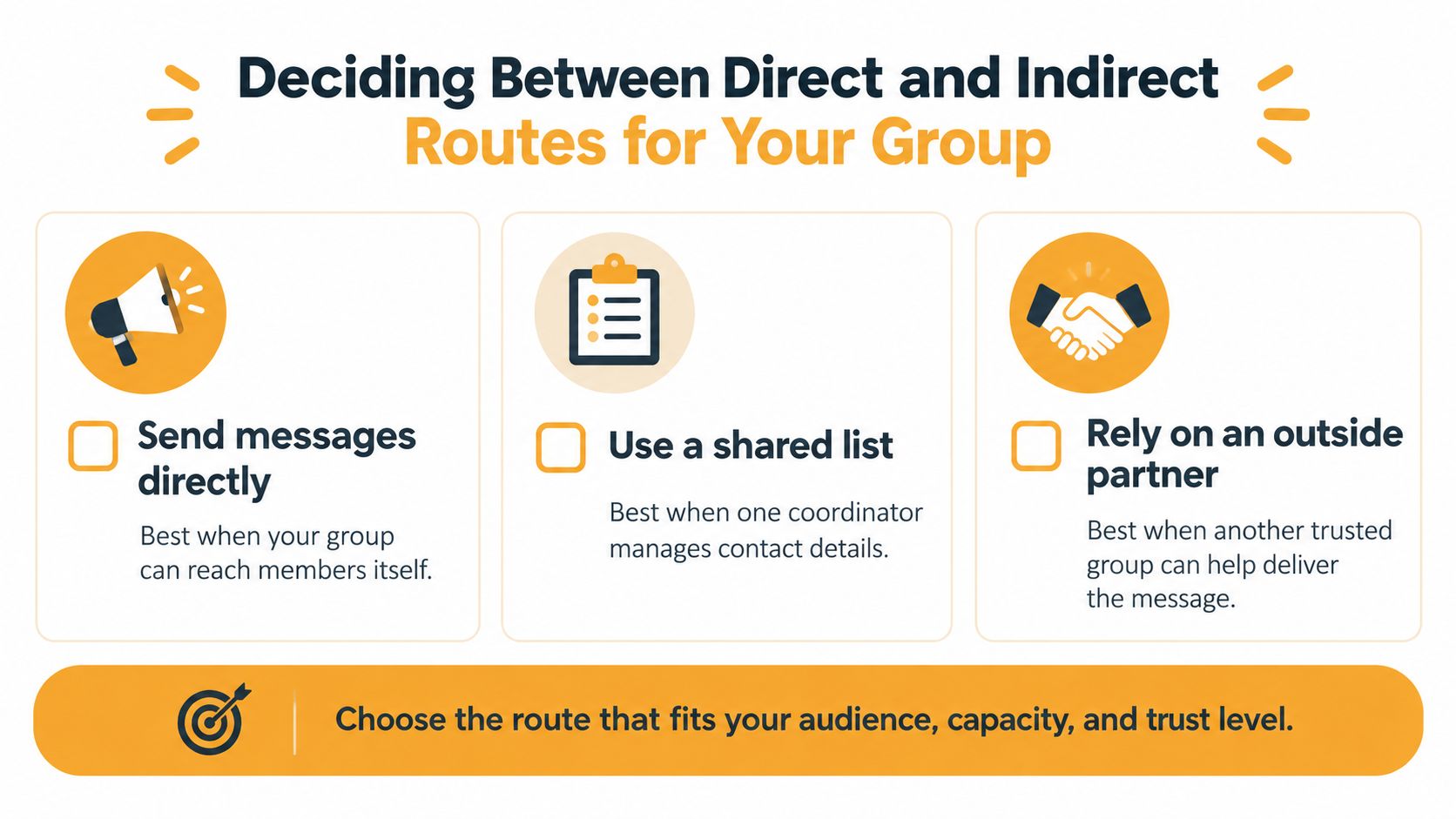
Here's the assumption worth challenging: indirect doesn't always mean less work. A partner or shared list can remove delivery and address-hunting tasks. It can also add coordination, data sharing, and ownership questions you didn't have before.
That pattern shows up in larger organizations too. Channel partners were used by 66.5% of surveyed marketing organizations in 2025, up from 61.5% in fall 2024, while improving data sharing was the leading management problem at 19.9%, followed by trust and loyalty at 18.6% and channel costs at 17.9%, according to The CMO Survey highlights and insights report. Growth in partner use doesn't remove management work. It changes where the work sits.
The checklist image below gives you the three basic routes to compare.
Six Checks Before You Choose
Run each route through the same questions.
- Setup effort: How long until a non-technical volunteer can send the first correct message?
- Member changes: Who adds newcomers and removes people who leave, and how often will that happen?
- Privacy: Can members see each other's personal addresses, and is that acceptable?
- Handoffs: If the treasurer or secretary changes next month, can the new person take over without begging for old emails?
- Exception handling: What happens when an address bounces, a reply goes astray, or the admin is on vacation?
- Exit portability: Can you export the member records and move if the tool or partner stops fitting?
Those checks expose the cost of email list hosting choices for volunteer groups far better than feature lists do, which is why it's worth reviewing practical guidance on email list hosting before you commit your membership records to one person's account. The same discipline applies when you research new contacts or partners, and prospecting guidance for cold email teams can help you think clearly about who you're trying to reach before any intermediary gets involved.
An intermediary earns its place when work disappears, not when it moves into scattered threads and private spreadsheets.
Ask one final continuity question. When your volunteer, distributor, or local representative changes, will recipients still be reachable tomorrow? If the answer depends on one person's memory, your channel isn't indirect. It's fragile.
Taking the Next Step With Your Group List
Start small this week. You don't need a perfect system. You need one clean route from sender to members that another volunteer could operate without you in the room.
First, write down who needs the message. Separate active members from old contacts who drifted away seasons ago. A distributor wouldn't stock shelves for customers who moved away, and you shouldn't maintain a list full of stale addresses.
A Low-Risk First Run
- Decide ownership: Name who holds the admin role and where the membership record lives. Write both down outside anyone's personal inbox.
- Create the group address: In Listava, you set up the shared address, add members by CC, or import them from an Excel spreadsheet.
- Send one practice message: Ask a few members to confirm delivery and test that a reply goes back to the group, not to one person.
- Check the awkward cases: Add a test member, remove one, and see how a wrong address behaves.
This is also the moment to agree on simple house rules. Who may post announcements? Should replies go to everyone by default? Those choices are easier before the first urgent message, not during it.
If you're comparing ongoing upkeep, reviewing email list management practices for small groups will help you spot which tasks you'll repeat monthly and which ones happen only at setup. Pay special attention to role changes. Note the backup admin now, while everyone remembers.
The best route for your group is the one members can use. No new account, no app download, and no extra training beats a clever system that half your members ignore. A good indirect channel of distribution, whether it moves bread or book club notices, should make delivery feel boringly reliable.
If your group needs one private address that reaches every member by standard email, without asking anyone to create an account or learn a new app, Listava is built for that job. Create your group list, add members by CC or spreadsheet import, and send your first practice message this week so the next volunteer inherits a route that still works.