Key Success Factors for HOAs and Community Groups
Learn what key success factors are, how HOA boards and community groups identify theirs, and which metrics show whether each one is working.
Your HOA has a repaving vote in two weeks, the book club is down to six regulars, and the volunteer chair who holds the member list is moving away. Good intentions and a long task list will not tell you what must keep working when an email goes missing or attendance drops.
Key success factors are the few conditions that must stay true for the group to reach its goal. When one fails, the goal fails with it. Poor communication puts project investment at risk and makes it harder for members to take part and for boards to make decisions that stick.
I recommend you keep the list short enough to guide decisions and concrete enough to check each month. For most volunteer groups that means naming the conditions that protect communication, participation, trust, money, and continuity after a leader leaves. Name the condition, name the person who watches it, and define what working looks like in plain terms the next chair can follow.
Table of Contents
- Key Success Factors Defined in Plain Terms
- Common Success Factors for HOAs and Community Groups
- How to Identify Your Group's Key Success Factors
- Metrics That Show Each Factor Is Working
- Key Success Factors in Three Community Groups
- Hidden Factors That Fail When Leaders Change
- Confirm Your Top Three Factors This Month
Key Success Factors Defined in Plain Terms
A bridge can have many components, but only a few load-bearing cables determine whether it stands. Paint and railings matter, but they can't compensate for a failed cable. Key success factors work the same way: they're the few conditions that carry your group's purpose.
Keep three ideas separate. A goal is the outcome you want, such as repaving a street or filling a book club calendar. A task is an action, such as collecting bids or sending meeting reminders. A success factor is the condition that allows those tasks to produce the goal, such as residents receiving the ballot notice in time to vote.
Test a proposed factor by asking whether the goal would fail without it, even if everyone made a strong effort. “Send a newsletter” is a task. “Members receive decision notices in time to act” is a factor. That distinction matters when a board changes hands: another volunteer can take over a task, but only if the group has identified and protected the condition the task supports.
Communication often belongs near the top of the list because it affects whether members can participate and decisions can be made. The Project Management Institute's communication findings report that 56% of project investment dollars are at risk because of ineffective communication. Projects in organizations with highly effective communication met their original goals 80% of the time, compared with 52% in organizations with minimally effective communication. Those findings concern projects, but the practical lesson applies to a volunteer group too: if members don't receive, understand, or respond to information, effort can't reliably turn into a shared result.

If this condition were missing, would the goal fail even with strong effort? Write your group's goal in one sentence before reading on.
Common Success Factors for HOAs and Community Groups
A dues vote fails when half the street never got the notice. A club fades when newcomers cannot figure out how to join. I recommend sorting groups by what keeps them running after the current organizer steps down, not by what looks good on paper.
| Success factor | Healthy sign | Warning sign | |---|---|---| | Reliable reach | Every member receives notices within a day | Notices arrive late or reach only some residents | | Clear decision rights | Votes and roles are written down and known | Decisions get made in side conversations | | Active participation | Replies and attendance stay steady through the year | Quorum fails or the same few people reply | | Trust and privacy | Members share contact details without hesitation | Residents ask who can see their addresses | | Continuity | Records and access survive a change of chair | Only one person knows where the list or password lives | | Financial transparency | Dues and budgets are reported on schedule | Members hear about money only during disputes | | Member clarity | Newcomers know how to join and take part | The same onboarding questions repeat in every thread |
The table is a starting point. Choose three to five factors that decide whether your group reaches its goal. Tracking all seven spreads volunteer time thin and leaves no one to act on the results.
Match the factors to the work in front of you. An HOA preparing a vote usually puts reliable reach and clear decision rights first. Residents need timely notice, and everyone should know who can call a vote and how it counts. For a book or hobby club, participation and member clarity often decide survival, because regular turnout matters and newcomers need a clear path in. Faith communities and extended family networks often lean on trust and continuity, especially when contact details stay private and coordination passes between volunteers.
Use the warning signs to narrow the list. Side conversations mean decision rights need work. Repeated onboarding questions mean member clarity needs work. Late notices mean reach needs work. Organizers dividing board duties can read more on structuring an effective HOA committee. To compare routine notices and group replies, review this rundown of HOA communication tools.
Circle the warning signs already showing up in your group. Start there this month.
How to Identify Your Group's Key Success Factors
Start with the goal, not the software, the calendar, or the current task list. A board trying to keep dues on track for a spring repaving vote needs different conditions from a club trying to sustain monthly participation. Work through these steps with the people who will have to maintain the plan.
-
Write the purpose in one sentence. Include a date if one matters, such as keeping dues on track for the spring repaving vote. A clear purpose gives the group a shared standard for deciding which conditions are critical.
-
List the outcomes that would cause failure. In a short working session, ask the board or committee what could prevent the purpose from being achieved. Capture possibilities before debating solutions so quieter members can name risks too.
-
Apply the failure test. For each candidate, ask whether the purpose would fail if that condition were missing, even with strong effort. Keep the items that pass, rather than promoting every useful activity into a success factor.
-
Combine overlaps and keep the list small. “Members receive notices” and “members can vote” may fit under one broader factor, such as reliable reach and participation. Aim for no more than five factors that the group can monitor.
-
Name an owner and a backup. Write down who is responsible for each factor and who can step in if that person is unavailable. Shared responsibility without a named lead often means nobody notices a problem until it disrupts a meeting or decision.
-
Choose one measurable signal for each factor. Use a number a volunteer can calculate from a spreadsheet, meeting record, or email log. Keep the signal simple enough that the next chair can reproduce it.
-
Set a review date. Put it on the calendar for the annual meeting or whenever the chair, treasurer, or list administrator changes. A scheduled review helps the group catch outdated assumptions before they become a handover problem.
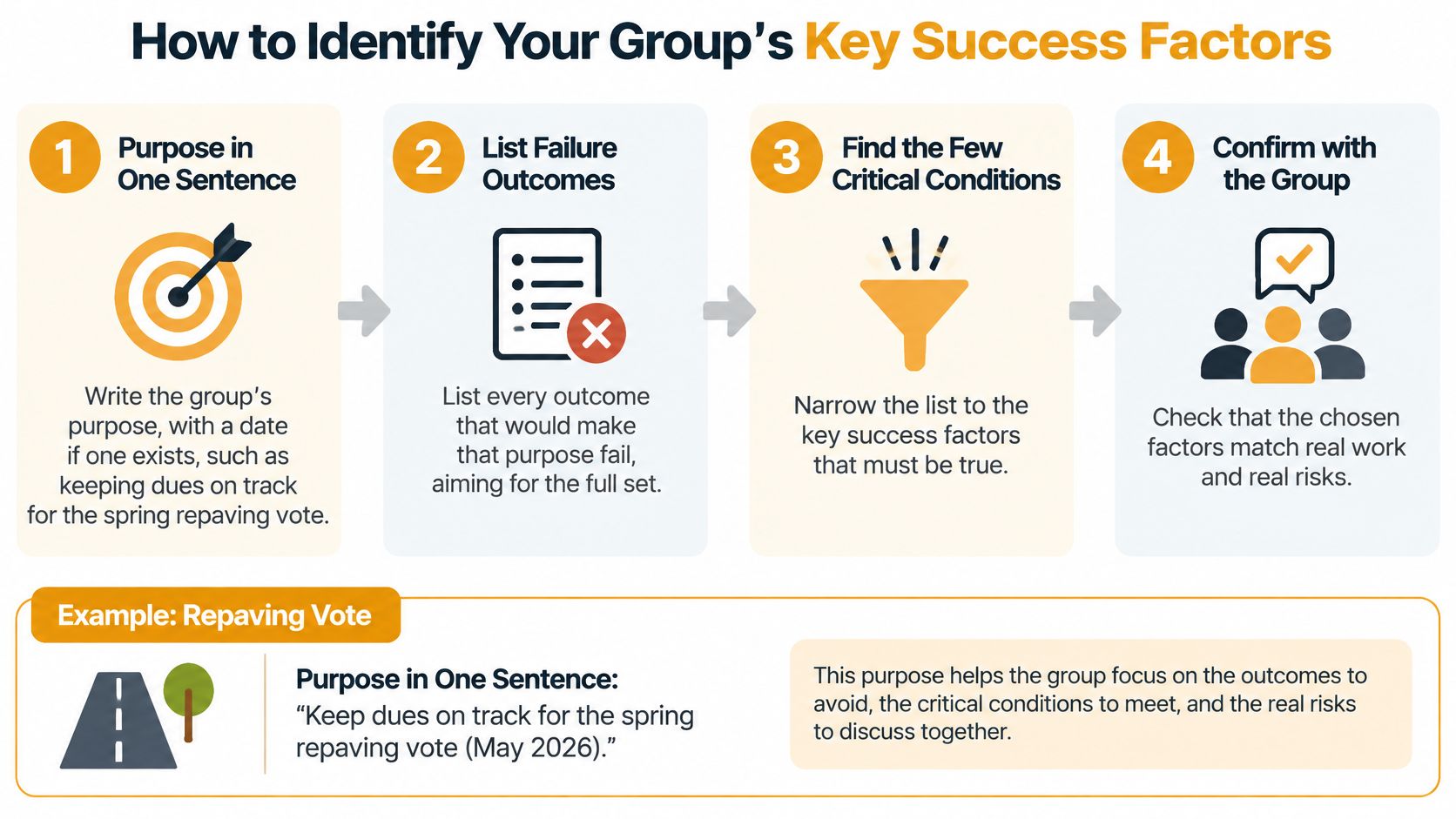
Two mistakes make this process less useful. The first is listing tasks instead of conditions, such as “send the newsletter,” without naming what that task protects. The second is keeping so many factors that nobody knows what to act on first. A good list lets a new board member read it and understand what the group must protect.
For help connecting priorities to members' needs, use this guide to build a member-focused association strategy. If the discussion needs a simple way to turn priorities into assigned work, adapt this free action plan template.
Metrics That Show Each Factor Is Working
| Metric | How to calculate | Suggested starting target | Check how often | |---|---|---|---| | Message reach | Delivered messages divided by current members | 95% or higher | Monthly | | Reply-all incidents | Threads with more than 10 replies per month | Under 2 per month | Monthly | | Meeting quorum | Attendees divided by eligible voters | At or above the bylaw threshold | Each vote | | Participation rate | Members who reply or attend divided by active members | Rising trend over two quarters | Quarterly | | Contact accuracy | Addresses that bounce or are reported wrong divided by total addresses | Under 2% wrong | Quarterly | | Onboarding time | Days from a join request to the first message received | Under 2 days | Each new member | | Handover readiness | Factors with a named backup owner divided by total factors | 100% | Annually | | Budget reports on time | Reports issued by deadline divided by reports due | 100% | Quarterly |
These targets are suggested starting points, not universal standards. Record your first reading as a baseline, then compare it with later readings over the first few months. If your group sends only occasional notices, for example, calculate reach from the notices it sent and keep the method consistent.
HOAs often have three useful first checks. Message reach tells you whether members receive notices; reply-all incidents signal that discussion threads may be crowding out decisions; meeting quorum shows whether enough eligible voters attended for a vote to be valid. Use the calculation that fits your bylaws and records, and don't treat delivery alone as proof that people understood the message.
Set the review rhythm to match the work. Check reach and reply-all incidents monthly, quorum at each vote, and contact accuracy, participation, and budget reports quarterly. Review handover readiness annually and whenever a key volunteer changes role. A short spreadsheet is enough if it records the date, numerator, denominator, and result.
Read the direction over two or three cycles, not a single month in isolation. One low reading may reflect a missed notice, a holiday, or a late report, rather than a persistent failure. If the same warning sign appears repeatedly, ask what process is breaking before you add another task or tool.
Key Success Factors in Three Community Groups
These hypothetical examples show how a group can connect its purpose to a few conditions and a number it can check. The best metric is one the next volunteer can calculate without needing a new system.
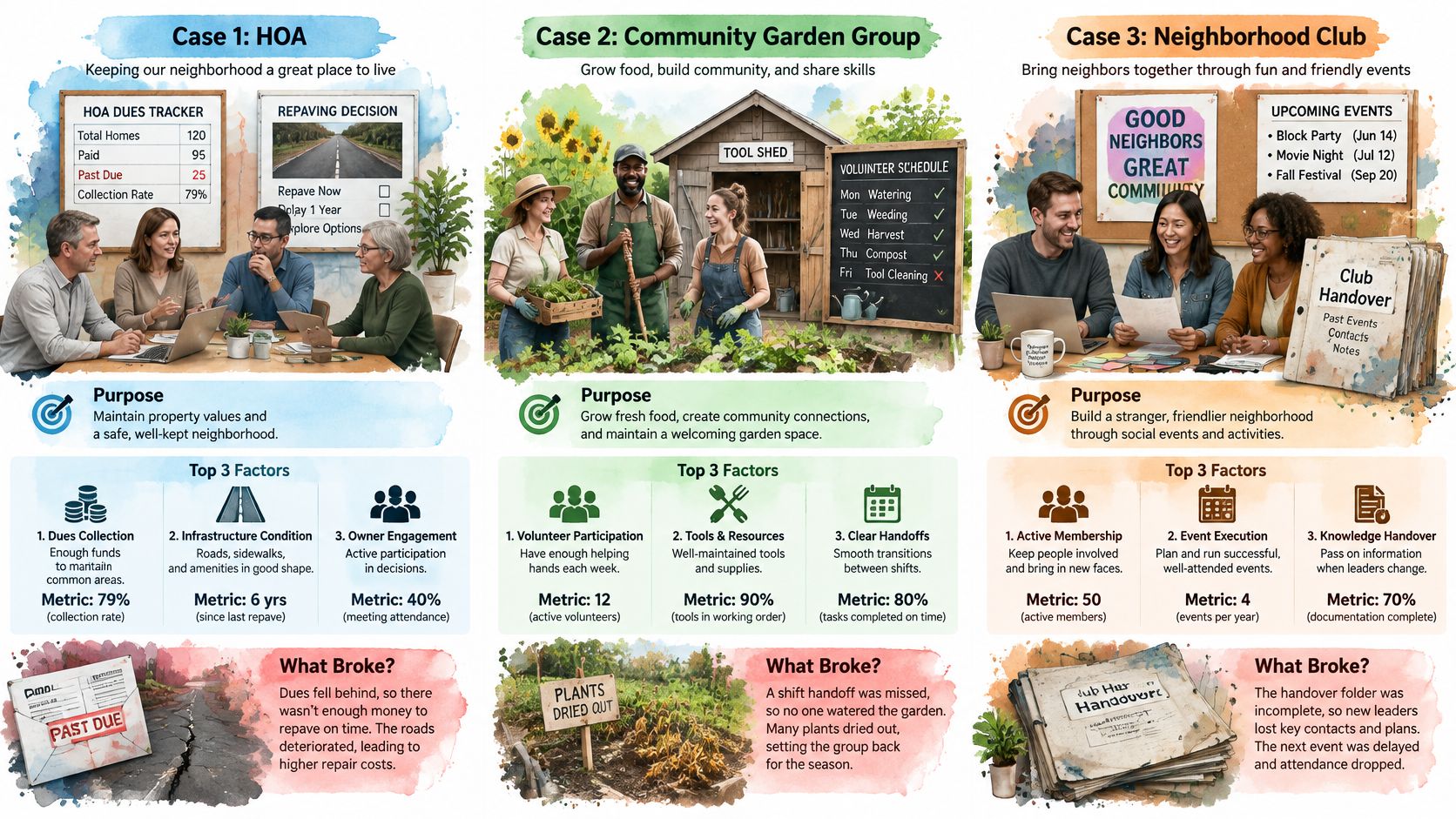
Hypothetical HOA case. The purpose is to pass a repaving vote in March. Its three factors are reliable reach, active participation, and financial transparency. The board tracks delivery rate for reach, the share of households that reply to the ballot notice for participation, and whether the reserve fund report goes out on time for transparency.
The problem emerges when members question whether the list is current. A check shows that the contact list is three years old, and only 81% of the notices reach their intended addresses. The board refreshes the list and repeats the delivery check before relying on another ballot notice. The number is useful because it identifies a specific failure point, not because a high delivery rate guarantees a vote.
Lesson: A ballot plan depends on a current list, not just a well-written notice.
Hypothetical book club case. The group's purpose is to finish one book each month. Its chosen factors are member clarity and participation, measured by days from a join request to the first message and the share of members who reply to the monthly poll. When newcomers don't know whether they're expected to finish the book or how to vote on the next title, poll responses fall. The organizer adds a short welcome note that explains the routine and gives a clear way to respond.
A coordinator should also consider who can use the selected communication channel. A 2025 study of Arabic-speaking immigrants and refugees reported that email was the least-used communication tool among the group studied, with language barriers and digital-competence challenges limiting access to services. That finding doesn't describe every community, but it's a reminder not to assume that an email-only route works for every member.
The final hypothetical case brings the issue to a weekly meal rota. The group's purpose is to cover each week's meals, with trust and privacy plus continuity among its factors. It measures contact accuracy and handover readiness. When a volunteer who has coordinated the rota for years steps away, some members don't respond to email and the next coordinator can't tell whether the list is current. The group offers a phone fallback and records who can update the rota.
A short video can help a committee discuss which checks are practical for its own routine.
Lesson: A communication channel is only useful if members can participate and someone else can keep it working.
Hidden Factors That Fail When Leaders Change
A long-serving chair announces she is stepping down at the March meeting. She kept the member list in her own inbox, she approved every addition, and she knew which addresses bounced last fall. After she leaves, the remaining volunteers have willing hands and a clear goal, but no reliable way to reach members or pass the work forward.
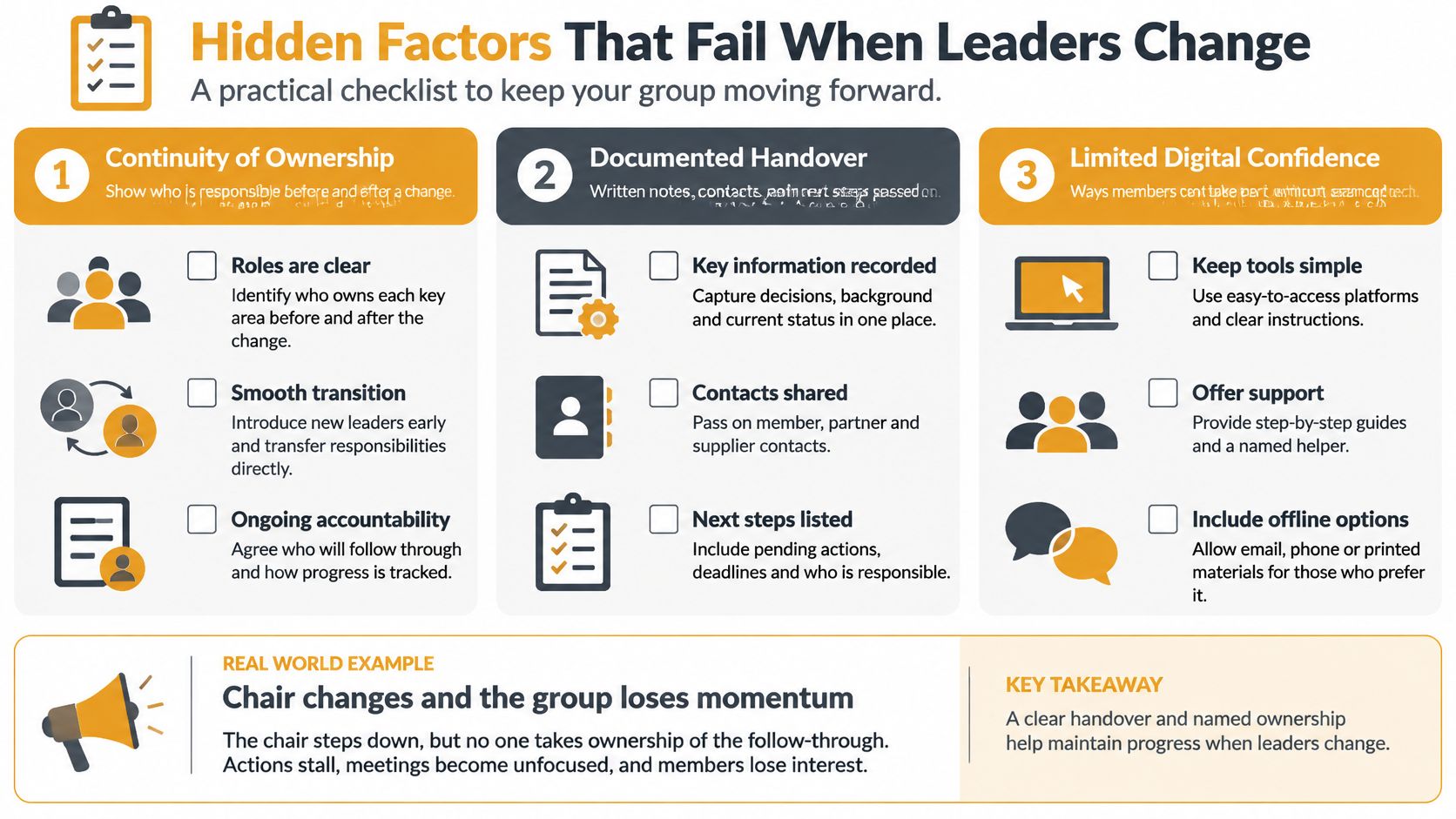
Continuity of ownership is the factor many groups forget to name. I recommend treating it as one of the few conditions that decides whether a volunteer group keeps working after its leader leaves. Write the governance answers down while the current coordinator is still available.
Name the role responsible for keeping membership records accurate, and record where the authoritative copy lives. Specify who can authorize a transfer of administrator rights and what the incoming organizer needs to receive. Set a process for checking additions, removals, and bounced addresses against current membership information. Make sure a named backup can carry out routine tasks without relying on the primary person's inbox or memory.
The 2025 Digital Technology in the Not-for-profit Sector report, summarized by Omatic found that 44% of organizations said staff and volunteers were confident using digital technologies. The same report found that organizations with an IT plan had 34% higher satisfaction with technology use. A small group does not need that level of planning. It needs ownership and basic steps that are clear enough for a new volunteer to follow in the first week.
Systems with more features often fail this handover test. Routine updates require an expert administrator. Members must learn a new dashboard to participate. Turnover then leaves behind settings no one understands. Communicating with a group of people you already know should not require software anyone has to be taught. Practical guidance on keeping club contact lists current through officer changes stresses the same point: keep the address stable and the upkeep simple.
Listava keeps group communication in familiar email clients, with one address that reaches every member and no accounts for members to manage. Users retain ownership of all content they submit.
Complete these three handover items this quarter:
- Write down the owner list. Include the person responsible for the member list, the person handling routine messages, and the person authorized to transfer access.
- Name a backup administrator. Confirm that person knows the routine steps and can send, add members, and check bounces if the primary volunteer is unavailable.
- Store a dated member-list copy outside one person's inbox. Protect access appropriately, and record when the list was last checked so the next coordinator can judge whether it needs an update.
Confirm Your Top Three Factors This Month
Use the next month to turn your chosen factors into a workable routine. Start with the three conditions that passed the failure test, not the three tasks that happen to be easiest to count.
- Choose the three factors most critical to your goal. Use the warning signs you already recognize to focus the group's attention.
- Name an owner and a backup for each. Put both names in shared notes that incoming volunteers can find.
- Record a first metric reading. Use the formula in the metrics table and label the result as the baseline, even if it falls short of the suggested target.
- Schedule a review. Add it to the next meeting agenda or the calendar for the next annual vote.
When a metric misses its target, check the warning sign for that factor first. Fix the likely cause, then compare results over the next two cycles rather than reacting to one unusual month. If your group relies on a shared inbox or personal address lists, a dedicated group address is one way to keep the contact point consistent when officers change.
For groups that want familiar email participation without member accounts, Listava uses encryption in transit and at rest, secure data centers, and regular security audits to protect information. Put your group's three success factors on the agenda for your next meeting, and assign someone to bring the first readings.
Listava gives a group one email address that reaches its members while helping protect personal addresses and keep replies with the group. If your current process depends on scattered CC lists or one volunteer's inbox, visit Listava to see whether a shared group address fits the way your members already communicate.