How to Run a Social Club: Setup, Members and Staying Power
Learn how to run a social club from first meeting to lasting membership: set rules, recruit, plan events, communicate and share the workload.
Fourteen people said they'd come to the first meetup. Nine showed up. Three months later you're the one booking the room, holding the cash box, and answering every reply, and every fact about the club lives in your inbox and your head.
That's the normal trajectory. Clubs rarely die from lack of interest. They die when the founding organizer moves house, changes jobs, or runs out of patience, and nobody else knows the venue contact, the bank login, or which six members haven't been seen since March.
Running a club well is a continuity problem wearing a social disguise. The setup decisions, the recruiting script, the event rhythm, the group address and the handover plan all answer one question: does this group still work when the person who started it steps back?
Table of Contents
- Settle the Purpose, Rules and Money Before the First Meeting
- How to Recruit Members Who Keep Coming Back
- Plan Activities Your Members Will Actually Attend
- Keep Everyone Informed Without Exposing Anyone's Email
- Share the Workload So the Club Survives a Leader Leaving
- Track Retention and Win Back Members Who Drift
- Confirm Your First Event Date This Week
Settle the Purpose, Rules and Money Before the First Meeting
The decisions that decide whether a club outlives its founder get made in the first three weeks, usually by accident. Five matter more than the rest, and every one has a default that most new clubs drift into.
| Decision | Common choice | Set it by | |---|---|---| | Membership scope | Open to anyone, or limited to a defined group | Before recruiting starts | | Dues | Flat annual fee, with event costs paid separately | Before the first collection | | Leadership | Chair, treasurer and secretary on two-year terms | At the founding meeting | | Decision rule | Majority of members present, with a written quorum | In the written bylaws | | Money account | Separate bank account, two signatures above a set amount | Before collecting dues |
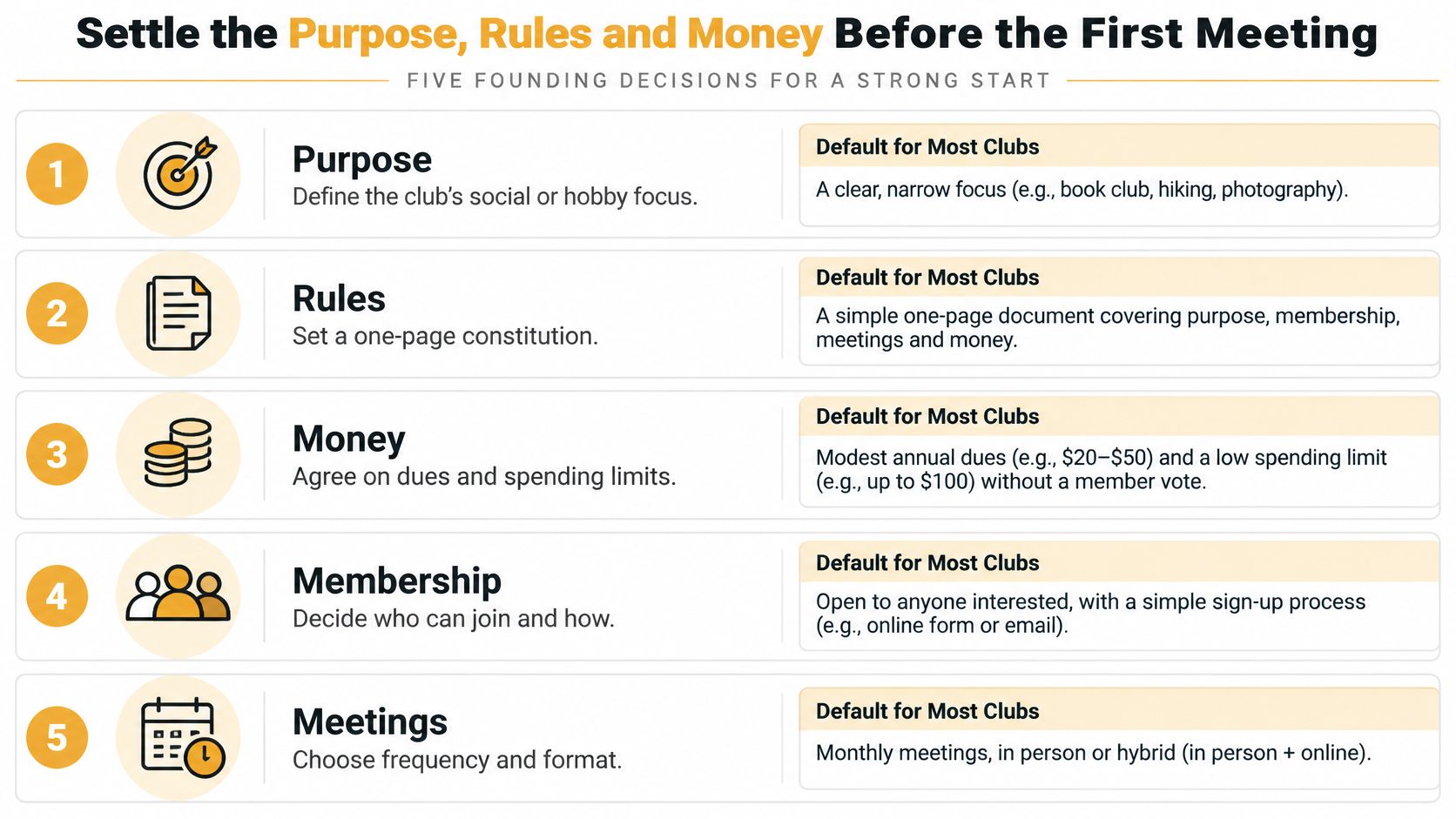
Membership scope is the one people fumble first. An open club and a defined-membership club produce different rooms, different conversations and different complaints. Write the answer in one sentence at the top of the constitution, because every later argument about guests, waiting lists and who votes resolves against that sentence.
Dues work best as a single annual fee with event costs billed separately. Bundling dinner into membership means the treasurer reconciles a variable bill every month while members who skip events ask for money back. A written dues schedule, approved before the first collection, ends that argument before it starts.
Leadership needs names on paper early: chair, treasurer and secretary on two-year terms, elected at the founding meeting with staggered start dates so the committee never turns over all at once. Add a written rule for replacing an officer mid-term, or the first resignation becomes a constitutional crisis.
In the United States, the IRS guidance on social clubs turns "member-supported" into something a treasurer can measure. A qualifying club is organized for social or recreational purposes with limited membership, and may generally take up to 35% of gross receipts from nonmember sources, with no more than 15% from nonmember use of club facilities or services. Keep member and nonmember income in separate columns and review revenue by source once a year.
Records should be boring and complete. The same guidance notes that clubs earning $1,000 or more in unrelated business income generally file Form 990-T, and that records separating income from expenses should be kept at least three years past the return's due date. Local law varies outside the US, but the discipline doesn't. Before the founding meeting ends, you want all five ticked:
- Purpose written on a single page in plain language
- Membership rules agreed and copied into the bylaws
- Dues schedule approved in writing, with amount and due date
- Separate bank account opened, never a personal one
- Two named signers on payments, one of them the treasurer
How to Recruit Members Who Keep Coming Back
Your first members come from the people you already stand next to: coworkers, neighbours, parents at school pickup, the regulars at your gym or the library group. Most of them aren't attached to anything like this yet. A 2025 national poll of 1,021 U.S. adults published by Marquette University found that only 13% reported belonging to a neighborhood association, block group, local club or group addressing local issues.
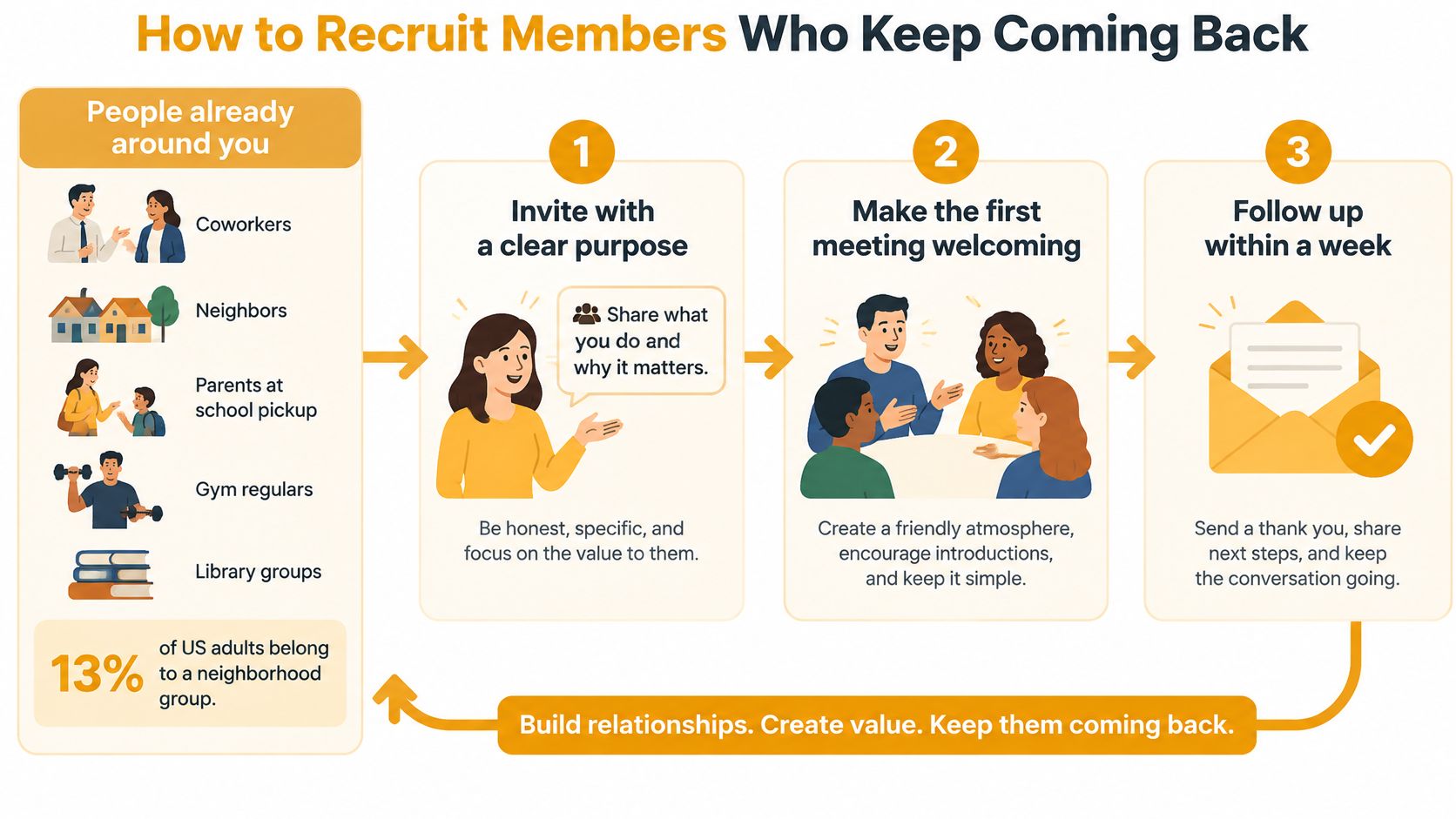
- Write a one-sentence promise. Who the club is for, what happens when you meet, how often. "A Sunday morning walking group for people in their forties who want company and a coffee after" recruits better than "a community social club," because people can tell in five seconds whether it's for them.
- List 20 to 30 people you know, then invite five by name. Personal invitations convert; broadcasts don't. Five individual messages beat two hundred flyers.
- Make the first gathering commitment-free. Pick a public place, set a clear start time, and name a greeter who watches the door and introduces newcomers to someone with a shared interest.
- Ask for a join decision within two events, not on the spot. Pressure at the first meeting produces members who pay once and disappear. Give people a second date and let them decide.
- Assign each new member a buddy for three activities. Someone who texts them the day before and looks for them at the door. This is the highest-return thing you can do in month one, and our guide to new member onboarding covers the follow-up steps worth copying.
- Record how they arrived. Join date, how they heard about the club, which event they first attended. That record tells you which recruiting channel works, and it's the first field you'll want when retention numbers arrive.
Something tangible helps at the first meeting, and a club shirt does more for belonging than another printed flyer. If you plan to order gear, compare bulk hoodie decoration methods before you commit, so the print method suits the fabric and the quantity you can sell.
Practical rule: Invite five people by name before you print anything.
The most common recruiting failure is a notice that says everyone is welcome but gives no date, place or host, so nobody knows what they're walking into. By the end of month one, I'd want at least half of the newcomers back at a second event. If fewer return, the problem is rarely the flyer. It's the first hour.
Plan Activities Your Members Will Actually Attend
A club with a rhythm survives. A club with one big annual event and nothing in between exhausts its organizer by month four. Pick a monthly anchor and one lighter habit, then let the same slot repeat so people can plan around it.
| Format | Best for | Lead time | Typical cost per person | |---|---|---|---| | Monthly meetup at a cafe | Low-commitment regulars | 1 week | Own purchase | | Recurring weekly walk or game night | Building a habit | 2 weeks | Near zero | | Themed dinner at a rented room | Deeper bonds among members | 4 to 6 weeks | $20 to $50 | | Day trip or outing | Members who want variety | 6 to 8 weeks | $15 to $40 plus travel | | Annual members-only event | Anchoring renewals | 3 months | Varies by venue |
The event run, from choice to debrief
- Pick the format from member answers, not your own taste. A two-question survey gets more honest data than a committee debate.
- Book anything needing a deposit at least six weeks out. Rooms and restaurants hold dates for whoever commits first.
- Confirm the cost per person and whether dues cover it. State it in the notice, in the same line as the date.
- Name a lead host and a backup. Two names on every event, agreed in advance.
- Publish what, where, cost and one reply deadline. People need a single action, not a form.
- Remind three days before, then send the exact address on the day. Half of all no-shows are people who couldn't find the door.
- Debrief within a week. Who came, who didn't, what to change. Two minutes in the committee chat is enough.
Say a book club swaps its monthly dinner for a fortnightly walk plus a quarterly dinner. Attendance holds through winter because the walk is cheap, short and doesn't need a reservation, and the dinner becomes an occasion instead of an obligation. A predictable next date beats novelty every time.
Before any deposit, check the venue's capacity limit, insurance requirements and safety rules, and confirm who carries the first-aid kit and the emergency contact sheet. Put that check on the lead host's written list so the backup can run the evening without phoning anyone.
Keep Everyone Informed Without Exposing Anyone's Email
The fastest way to lose a member's trust is to put forty addresses in the CC field. The second fastest is a BCC blast that nobody can reply to.

Compare the three options side by side. Plain CC works fine for six people who all know each other, until someone replies-all with a complaint or a member's address ends up forwarded outside the group. BCC protects addresses but breaks the conversation: replies go to one inbox, people drop off the thread, and the organizer becomes a human relay. A shared group address sits between the two. One address reaches everyone, replies return to the group, personal addresses stay hidden, and the list belongs to the club rather than to whoever set it up. Members are added by CC'ing them, and creating the group takes about thirty seconds.
Privacy baseline: member addresses are never shared, sold or pasted into a document that leaves the committee.
Inclusion is the part most guides skip. Digital channels still carry the load, with Daxko's nonprofit trends research reporting that 89% of nonprofits say digital communications remain critical, even as in-person participation rebounds: active members rose 4.5% year over year, facility check-ins rose 5.8%, and virtual check-ins fell 28%. Yet only 45% of surveyed club leaders thought their club communicated member value well, and just 48% said they measured it effectively. The answer isn't online or in person. It's one low-friction channel that reaches everyone, plus a good room.
The walkthrough below shows the setup in practice.
Build to this baseline:
- A plain-text notice with date, time, place and one action
- An email route for members who avoid apps and group chats
- A phone call to anyone who hasn't replied after two announcements
- A reply request in the first message, to confirm delivery works
- No accounts required, so nobody is locked out by a forgotten password
Measure reach by replies and attendance, not follower counts. Members don't need another login, and they don't need to learn a dashboard to hear that Thursday moved to Friday. If you're reworking how the list behaves, read these notes on email list privacy before you migrate anyone. Photo sharing is where group threads go to die, so use one upload link per event instead of a reply-all chain; if you're coordinating a season of any kind, this explanation of how to stop chasing parents for match photos will save the committee a month of nagging.
Share the Workload So the Club Survives a Leader Leaving
A chair resigns halfway through the season. If that person also controls the booking logins, member records and committee email, ordinary club business can stall before anyone has agreed to take over. Build continuity into the roles, records and communication routines while the club is running.
Research on rural Australian volunteers links burnout to heavy workloads, time demands, too few volunteers, bureaucracy and limited funding. Volunteers may respond by sharing or reducing duties, refusing extra work, or stepping back without notice, according to this study of volunteer burnout and continuity. Make roles small enough for people with limited time to accept, and assign a backup before a task becomes urgent.
| Role | Core tasks | Backup needed | |---|---|---| | Chair | Agenda, meetings and final decisions | Vice chair named before the term starts | | Treasurer | Dues, bank reconciliation and reports | Second signer who can reconcile the books | | Membership coordinator | Joins, renewals and member records | Shared list committee members can access | | Event lead | Bookings, schedule and host roster | Co-host rotated for each event | | Communications coordinator | Announcements, reminders and replies | Second sender with access to the group address |
Every critical task needs a second person who knows how to do it.
Use five practices to make handovers manageable:
- Keep club records in a shared folder. Store bylaws, minutes, the member register and vendor contacts there, rather than in one volunteer's inbox.
- Stagger two-year terms. A partial committee change preserves experience and gives incoming volunteers someone to ask.
- Arrange a shadow handover. Have the incoming volunteer observe at least one meeting or event, then give them a chance to handle the task.
- Review the workload quarterly. Check hours per event, tasks without backups, overdue actions and how widely members are sharing the work. Use the review to reassign duties before one person becomes the default for everything.
- Allow the club to pause a season. A planned pause gives members a chance to regroup; continuing at any cost can leave the club dependent on an exhausted organizer.
Watch for tasks that go unclaimed, handovers that keep slipping and one person answering every reply. Communication continuity is part of governance: agree who can send announcements and how the next organizer will take over. These volunteer communication practices can help a committee keep members informed through a role change.
Track Retention and Win Back Members Who Drift
A single retention percentage hides almost everything. A club can keep members on paper while attendance drops, volunteers vanish and the room gets quieter every month. Start with a formula you can defend: members active at both the start and the end of the period, divided by members active at the start, multiplied by 100.
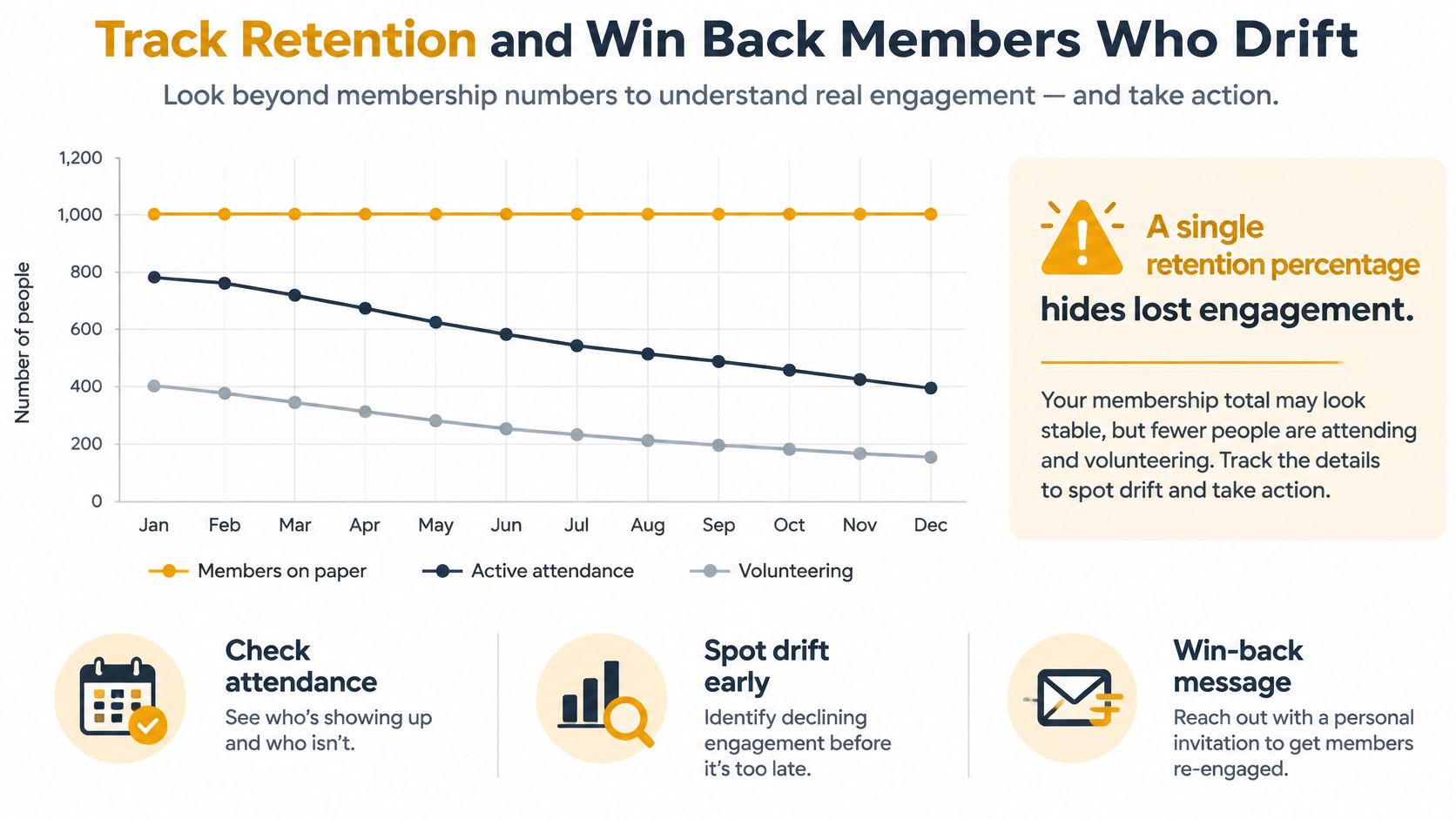
Track first-year members as a separate cohort, because new members renew at lower rates than established ones. The comparison points worth having in front of you, from Campai's member retention benchmarks, are a median overall renewal rate of about 85% and a first-year renewal rate of roughly 75%. Treat those as yardsticks rather than targets, and segment your own results by club type, dues level and member lifecycle before drawing conclusions.
The monthly cycle that makes the numbers useful
Send renewal reminders before the deadline rather than after it. Contact a member once they've gone quiet instead of waiting for renewal season. Set an engagement-risk flag when someone misses two or three consecutive activities, and record cancellation reasons as moving away, no time, cost, or feeling left out. Test any win-back message on a comparable group of inactive members before you send it to everyone, so you know whether the message worked or the season did.
| Metric | How to calculate | Review action | |---|---|---| | Annual retention | Members active at start and end ÷ members active at start × 100 | Compare with about 85% median | | First-year renewal | First-year members renewed ÷ first-year members due to renew × 100 | Compare with about 75% median | | Monthly attendance rate | Attendees ÷ active members invited × 100 | Track the month-to-month trend | | Reactivation rate | Inactive members who attended again ÷ inactive members contacted × 100 | Compare against the control group | | Engagement-risk flags | Members missing two or three consecutive activities | Contact each flagged member |
One honest conversation often does more than the email. Ask what changed, and you'll hear about a shifted shift pattern, a new baby, or a friend who stopped coming and took the reason with them.
Confirm Your First Event Date This Week
Pick a date within the next 14 days for a no-commitment gathering and send personal invitations to five people from the list you wrote earlier. That's the whole assignment. Everything else can wait until after the first evening.
Before the date, finish three things. Write the one-page purpose, membership and dues note so you can answer "so what is this?" at the door. Open the shared folder and add the member register with its first row filled in. Name a host and a backup, and tell both of them who does what.
At the gathering, use a clear start time, a greeter at the door, a short round of introductions, and one next date announced before anyone leaves. Afterwards check three things: how many came, whether anyone asked how to join, and whether second-event attendance is on track. Print a year calendar for the wall where the committee meets; these printable Monday-start yearly calendars let you mark event dates and dues deadlines in the same place. A perfect launch isn't the goal. A second date on the calendar is.
Listava gives a club one shared email address that reaches every member, so the list outlives the organizer and nobody has to create an account or install an app to take part. Visit Listava to see how a group address handles announcements, replies and member privacy in a single place. Set your first event date this week, then hand the address to whoever comes next.